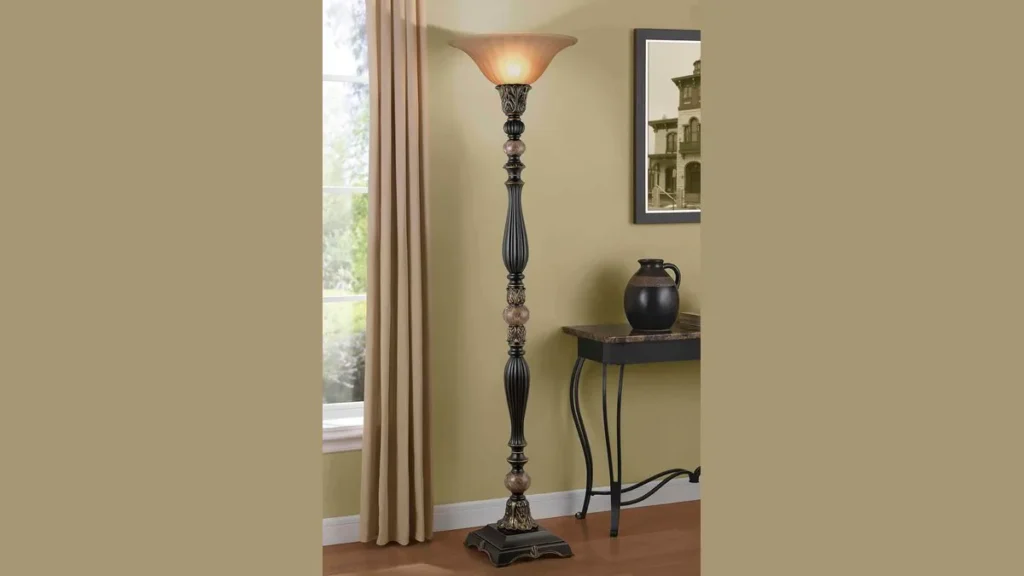
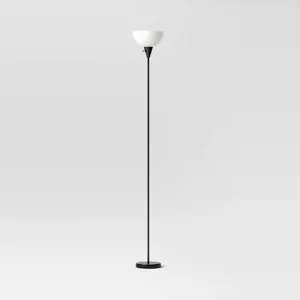
What Is a Torchiere Floor Lamp is a tall standing lamp that throws most of its light upward onto the ceiling, which then bounces soft, indirect light back down into the room. The word comes from the French torche, meaning torch. The shade sits at the top and opens toward the ceiling, so you get room-wide glow instead of a bright pool on one table.
Torchiere floor lamp basics
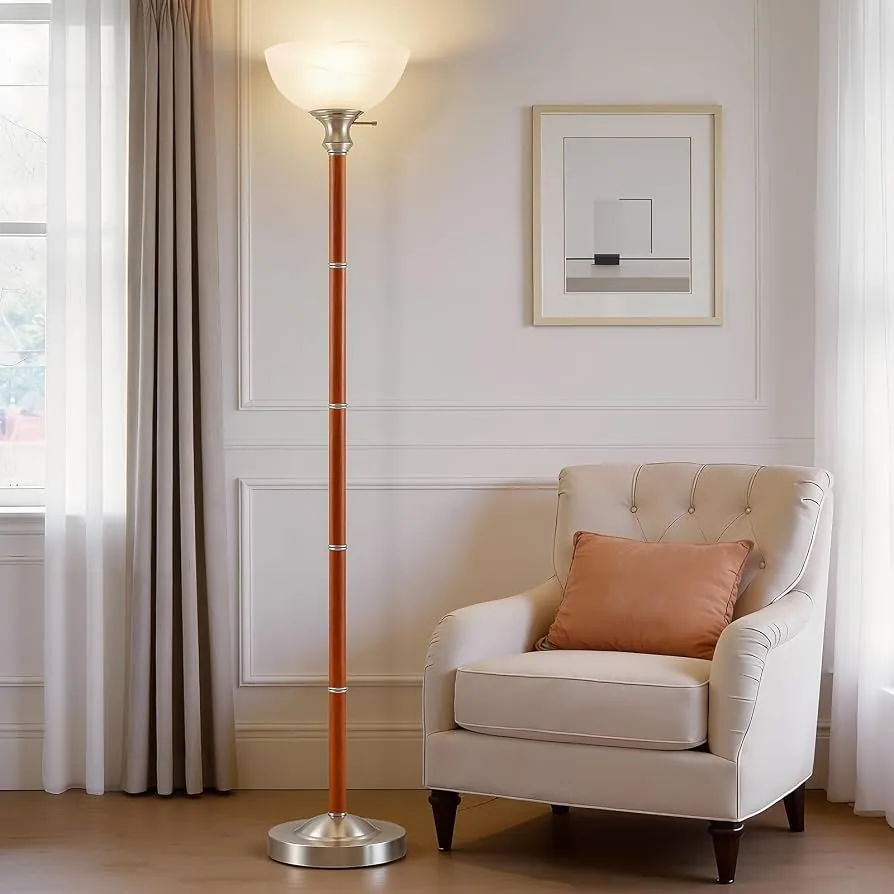
- A torchiere sends light up, not down. The ceiling acts as a giant reflector, so the whole room brightens without a visible bulb in your eyes.
- Standard height runs about 5 to 6 feet (1.5 to 1.8 m). Shorter ones around 4 feet suit reading nooks; taller ones suit rooms with 9-foot ceilings.
- Older models used a single halogen bulb up to 300 watts and ran hot. Modern LED torchieres often use 20 to 40 watts total and stay cool to the touch.
- The open top means the bulb is exposed. On a halogen torchiere, that hot bulb can ignite curtains or paper that touch it — the U.S. Consumer Product Safety Commission has warned about this fire risk.
- A dimmer switch changes the mood more than the bulb does. Most torchieres with a built-in dimmer let you drop from full brightness to a low glow in one turn.
- Best room fit: living rooms, bedrooms and offices with a white or light ceiling at least 8 feet high. Dark ceilings absorb the light and kill the effect.
Why torchiere light feels softer than a table lamp
Light bouncing off a ceiling spreads out before it reaches your eyes. A table lamp aims a bright cone at one spot, so your eye sees the source and the sharp shadow it casts. A torchiere hides the source from your line of sight, and the ceiling turns one bright point into a wide, even wash. That’s why a torchiere makes a small room feel bigger and a dark corner feel less heavy.
The ceiling you have decides how well this works. A flat white ceiling reflects most of the light back down. A dark, textured or vaulted ceiling reflects less and scatters what’s left, so the same lamp looks dimmer. If your ceiling is dark, you’ll need more wattage or a second light source near where you actually sit.
Height matters for the same reason. A torchiere placed too low throws light at a sharp angle and lights only part of the ceiling. Place it so the top sits roughly 1 to 2 feet below the ceiling, and the bounce spreads evenly across the room.
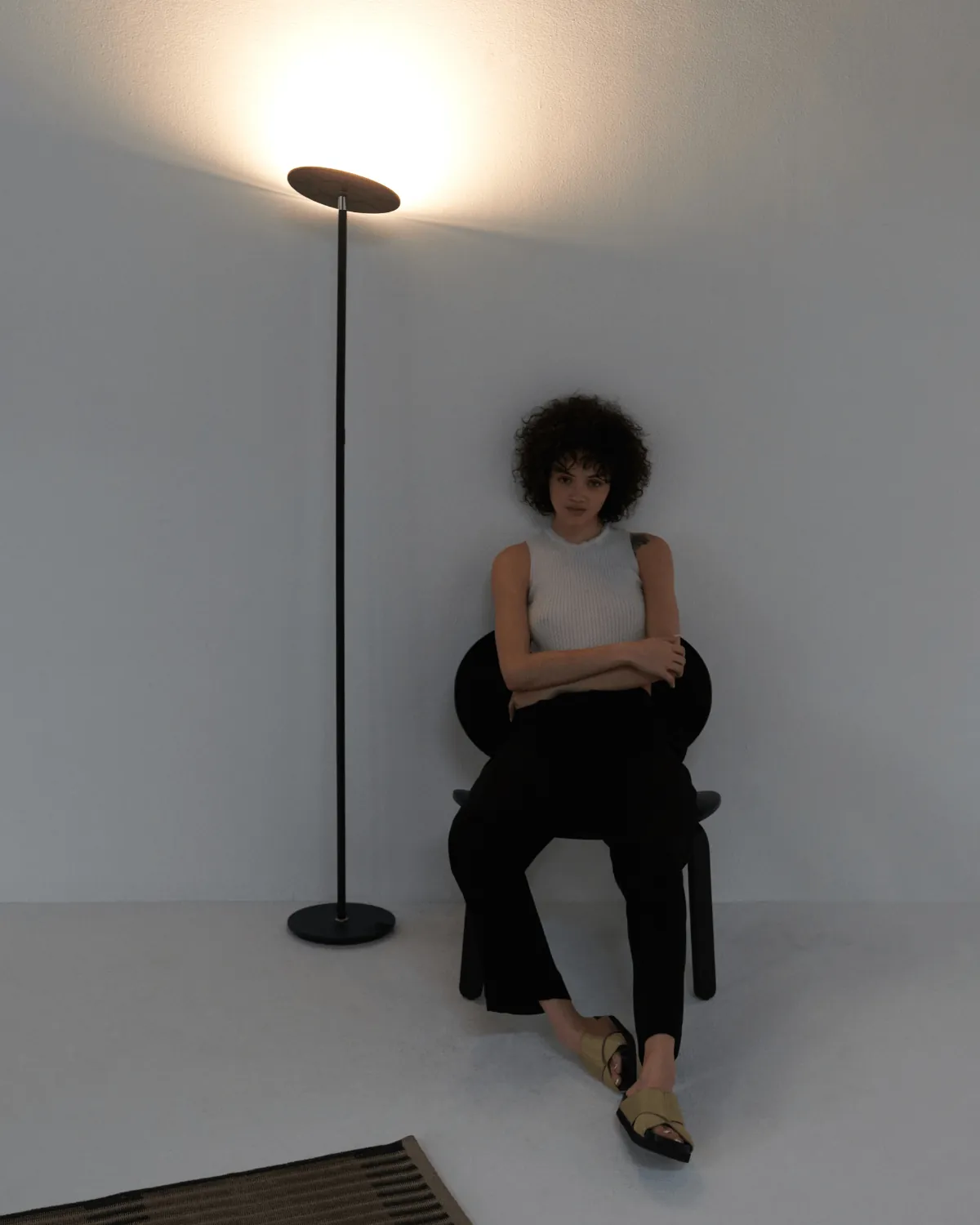
One more thing people miss: a torchiere lights a room, not a page. The upward beam leaves the area below the shade in relative shadow. That’s fine for watching TV or talking. It’s not fine for reading, sewing or eating, where you need light aimed at the task.
When a torchiere isn’t the right pick
A torchiere solves one problem — filling a room with soft, indirect light — and it fails at several others. The table below covers the cases where you should choose something else, or add a second lamp.
| Situation | What changes | What to do instead |
|---|---|---|
| You read in that chair | No light reaches the page | Add a task lamp beside it |
| Low or sloped ceiling | Beam hits the wall, not ceiling | Pick a shorter torchiere |
| Dark or wood ceiling | Light gets absorbed, room stays dim | Choose higher lumens or skip it |
| Small kids or pets | Hot halogen bulb is reachable | Use an LED torchiere only |
| You want a bright desk | Upward beam misses the work | Use a desk lamp with a down shade |
| Very small room | Ceiling bounce can feel flat | Combine with one warm accent light |
How to choose and set up a torchiere
- Measure your ceiling first. Stand where the lamp will go and check the height. For an 8-foot ceiling, pick a torchiere around 5 to 5.5 feet tall so the top sits 2 to 3 feet below it; for a 9-foot ceiling, a 6-foot lamp works better. Write the number down before you shop.
- Check the bulb type and wattage on the label. LED models list a wattage equivalent, such as “100W equivalent, 15W actual.” Halogen models list the maximum wattage the socket allows — never fit a bulb above that number, because the socket and wiring are rated for it and nothing more.
- Match the color temperature to the room. Look for 2700K to 3000K for bedrooms and living rooms, which gives a warm white glow. Anything at 4000K or above looks blue-white and suits an office or workshop better. The kelvin number is printed on the bulb box.
- Set the dimmer at the lowest setting first. Turn the lamp on low, then raise it until the room feels right. This tells you fast whether the lamp is bright enough for the space, and it saves you from buying a second one you don’t need.
- Place it 1 to 2 feet away from curtains, paper and fabric. Heat builds up near the shade on halogen models. Keep the top of the lamp clear of anything that can drape over it, and never let a curtain touch the bulb.
- Check the base and stability. A torchiere is top-heavy by design. Put it on flat floor, not carpet with a thick pile, and keep the cord out of walkways. If it wobbles when you brush past, move it against a wall.
- Test the bounce from your seat. Sit where you’ll actually sit and look at the ceiling. If you see one bright hot spot, the lamp is too low or too close to a wall; move it out and the spot spreads.
- Clean the shade and bulb when you dust. A film of dust on the reflector or bulb cuts output. Wipe both with a dry cloth when the lamp is off and cool, about once a month in a dusty home.
Mistakes that spoil a torchiere setup
- Fitting a higher-wattage bulb than the label allows. The socket, wiring and shade are rated for a maximum, and going over it overheats the fitting. On a halogen torchiere that’s a genuine fire risk, not a small one.
- Putting it in a corner behind furniture. The light hits the wall and stops there, so half the room stays dark. Pull it out at least a foot from the wall for a full ceiling bounce.
- Buying on looks and ignoring the ceiling. A dark ceiling swallows most of the output, and no amount of styling fixes it. Check the ceiling color and height before you fall for a design.
- Using a torchiere as the only light for reading. The page sits in shadow while the room glows, which strains your eyes. Pair it with a small task lamp and the room still feels soft.
- Leaving a halogen model on for hours in a closed room. Heat builds up with nowhere to go. If the shade feels too hot to touch, turn it off and switch to an LED model.
Frequently asked questions
What is a torchiere floor lamp used for?
It’s used for indirect, room-wide lighting — the upward beam hits the ceiling and bounces soft light back down. That makes it a good fit for living rooms, bedrooms and offices where you want general glow, not a bright spot. It works best as ambient light alongside a smaller lamp for reading or tasks.
Can a torchiere lamp be used for reading?
No, not on its own. The light points at the ceiling, so the page below the shade stays dim. Add a task lamp or a reading lamp next to your chair, and keep the torchiere on low for background glow. That combination gives you both comfort and enough light on the words.
Why does my torchiere look dim even at full power?
Your ceiling is the reason in most cases. A dark, wood or textured ceiling reflects far less light than a flat white one, so the same lamp reads dimmer. Check the ceiling color and height first; if it’s dark, raise the lumen output or move the lamp closer to where you sit.
Is it safe to leave a torchiere lamp on all night?
It’s safe if it’s an LED model and the shade stays cool. A halogen torchiere runs hot enough to ignite nearby fabric, which is why the U.S. Consumer Product Safety Commission has issued warnings about halogen torchiere fires. Check the shade with your hand; if it’s too hot to touch, don’t leave it running unattended.
How tall should a torchiere floor lamp be?
Match it to your ceiling. For an 8-foot ceiling, a lamp around 5 to 5.5 feet tall leaves the right gap; for a 9-foot ceiling, go closer to 6 feet. The goal is a top that sits roughly 1 to 2 feet below the ceiling, so the beam spreads instead of forming one hot spot.
What bulb goes in a torchiere floor lamp?
It depends on the socket and the label. Many modern torchieres take an LED bulb rated at 2700K to 3000K for warm light, while older ones take a halogen bulb at the maximum wattage printed on the fitting. Never go above that number — the socket and wiring aren’t rated for more.
Does a torchiere need a dimmer?
No, but it changes how useful the lamp is. A dimmer lets you run it bright for cleaning and low for evenings, so one lamp covers more of the day. If your model lacks one, a plug-in dimmer switch between the cord and the outlet does the same job.
Can I put a torchiere on carpet?
Yes, if the carpet is firm and the base sits flat. Thick, deep-pile carpet lets a top-heavy lamp wobble, and a wobble is how these lamps tip. Press the base down, check for movement, and move it to a hard floor or a flat board if it shifts.
Conclusion
A torchiere earns its place when you want a room to feel lit without a bright bulb in your eyeline. Check your ceiling height and color first, keep the top clear of fabric, and pair it with a task lamp anywhere you read. Get those three right and it does its one job well.